
When Does a Business Branch Need Its Own Local SEO Page?

Picture a customer trying to collect a repaired device before a shop closes. The search result names the right city, but the page gives the head office address and a phone number for general sales. A branch page earns its place when it helps someone make a decision about that specific location.
Test the case for a separate URL
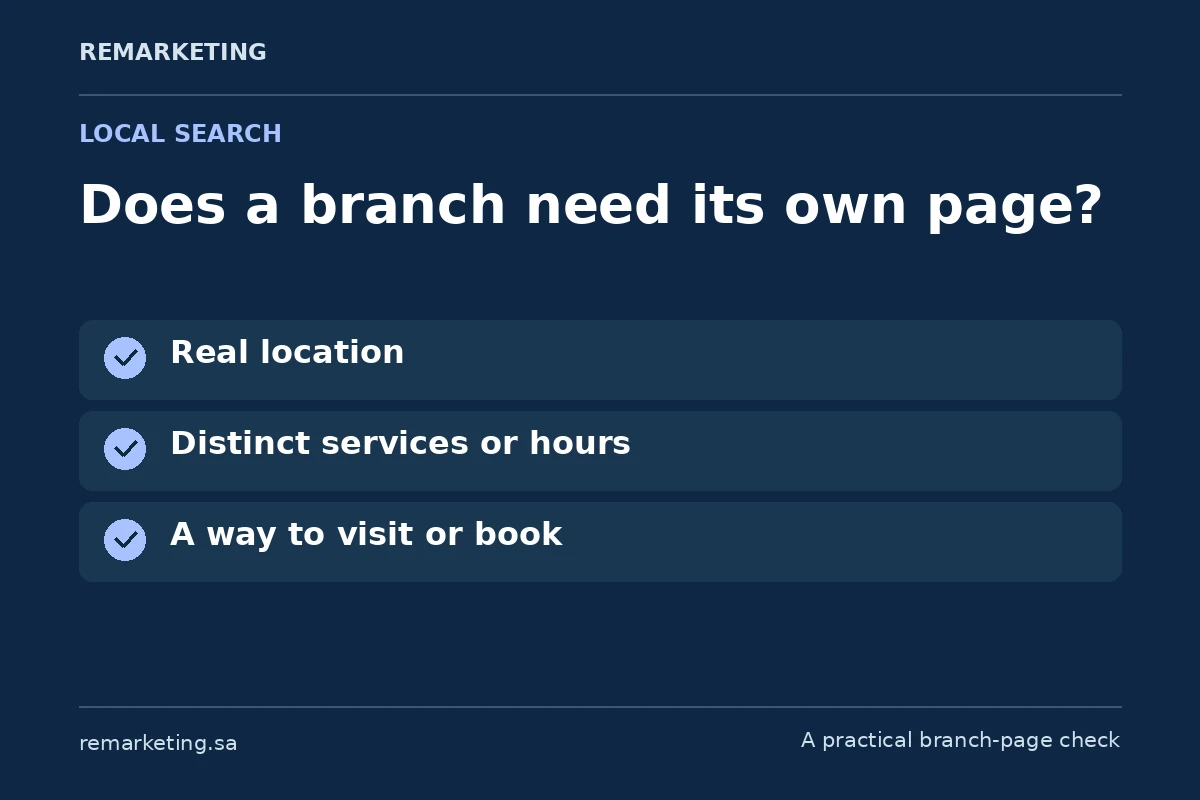
Ask three questions. Is there a real location customers can visit, or a distinct local operation the business can accurately describe? Does this location have different hours, services, access arrangements or booking requirements? Can the visitor take a meaningful next step for that location? The answers guide the structure of the website. Eligibility for a Google Business Profile is a separate decision.
| Business setup | Useful site structure | Detail that changes the customer’s decision |
|---|---|---|
| Riyadh and Jeddah storefronts with different services | A branch page for each location | Which branch accepts repairs or offers collection |
| One mobile team covering several districts | A service page with a coverage section | Where the team travels and how to book a visit |
| An administrative office closed to visitors | Accurate contact and service instructions | Where customers should actually go or call |
Write the page from a visitor’s point of view
Lead with the branch name, a reliable map link, opening hours and a working contact route. State which services are available. For an illustrative retailer, the Riyadh branch might accept repairs while Jeddah handles collection only. A sentence explaining that difference is more valuable to a customer than a long introduction about the city.
Link to the branch from a location directory and link out to the services available there. When the site serves Arabic and English readers, each language switch should land on the same branch. Use the bilingual website checklist before releasing the second version.
Connect the correct profile and test the visit
Follow Google’s business representation guidelines when deciding whether a location qualifies for its own profile. If a team travels to customers, check the service-area rules before publishing an address as a public storefront. Where an eligible branch has a profile, its phone or website should represent that location. Google’s search spam policies also cover sets of near-identical city pages that funnel visitors to one destination.
Give someone a phone and ask them to find today’s collection hours, confirm the service they need and reach the right branch. Their first unanswered question is your next edit. For a broader city-level example, see the guide to local search in Jeddah.